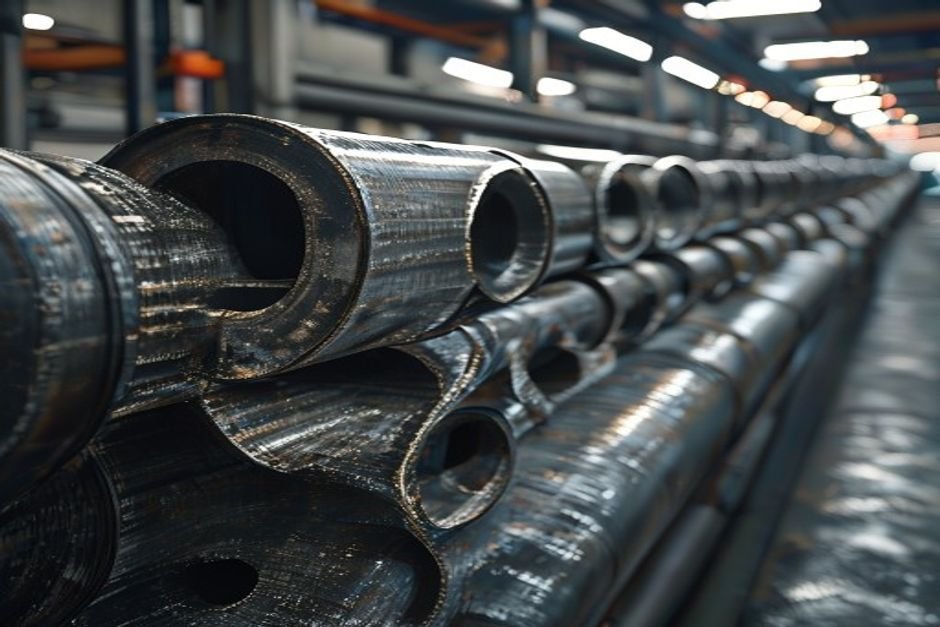
Pipe grade is the single decision that most often decides whether a line runs for twenty years or fails an inspection in its first shutdown. Here is how our materials desk works through it.
On a high-pressure line, the pipe is the cheapest component and the most expensive one to get wrong. Replacing a spool costs a few thousand riyals; an unplanned shutdown to replace it costs several orders of magnitude more. Yet grade selection is routinely reduced to a line item on a purchase requisition — “6" SCH 80 CS” — with no note on service, temperature, or the corrosive species in the stream.
Below is the sequence our materials team follows when a client sends us a line list. It is deliberately ordered: each step narrows the field before the next one begins.
1. Start with the design conditions, not the catalogue
Before anyone opens a stock list, four numbers need to be fixed: design pressure, design temperature, corrosion allowance, and the required design life. Design pressure and temperature come from the process datasheet, and together they set the allowable stress that ASME B31.3 will let you use. Note that allowable stress falls sharply above roughly 400°C for most carbon steels — a grade that is comfortable at ambient may be marginal in a hot service.
- Design pressure and temperature — these drive wall thickness through the B31.3 formula.
- Corrosion allowance — commonly 1.5 mm or 3.0 mm; it is added to the calculated thickness, not absorbed by it.
- Fluid category — normal, Category D, Category M, or high-pressure fluid service changes the examination and testing requirements.
- Design life — a 25-year line justifies a corrosion-resistant alloy that a 5-year temporary line does not.
2. Decide seamless or welded
This is the choice that generates the most debate and the most misinformation. Seamless pipe has no longitudinal weld, so it has no weld joint efficiency penalty (E = 1.0) and no seam to inspect. ERW and LSAW welded pipe carry a joint efficiency of 0.85 to 1.00 depending on the level of radiography applied, which directly increases the required wall thickness for the same pressure.
| Factor | Seamless (SMLS) | Welded (ERW / LSAW) |
|---|---|---|
| Joint efficiency (E) | 1.00 | 0.85 – 1.00 with full RT |
| Typical size range | Up to 24" | From 2" up to 60"+ |
| Wall thickness consistency | ±12.5% mill tolerance, more eccentricity | More uniform, from plate/coil |
| Cost at large diameter | High | Considerably lower |
| Preferred for | High pressure, cyclic, sour service | Large-bore utilities, water, low-pressure gas |
The practical rule: below 16 inches in a pressure-critical or cyclic service, specify seamless. Above 16 inches, or in a utility line where pressure is modest, high-quality welded pipe to API 5L or ASTM A672 is the economically correct answer and there is no technical reason to pay a seamless premium.
Seamless is not automatically “better” — it is better for a specific set of duties. Specifying it everywhere is how procurement budgets quietly double.
3. Match the grade to the service
Once the form is settled, the grade follows the fluid and the temperature. These are the workhorses we stock and supply most frequently across the Eastern Province:
ASTM A106 Grade B — the default for hot service
Killed carbon steel, seamless, intended for high-temperature service. It is the standard choice for steam headers, hot oil and general process lines running above ambient. Its silicon content gives it better high-temperature behaviour than A53, which is why it dominates refinery piping.
ASTM A53 Grade B — utilities and ambient service
Available seamless or ERW, and less expensive than A106. Entirely appropriate for firewater, plant air, cooling water and structural applications. It is not the right choice for elevated-temperature process duty.
API 5L (PSL1 / PSL2) — transmission and pipeline duty
Specified by grade (B, X42 through X70) with increasing yield strength. PSL2 adds tighter chemistry limits, mandatory impact testing and carbon equivalent control — insist on PSL2 for anything pressure-critical or sour.
ASTM A333 Grade 6 — low temperature
Impact tested to −45°C. Required wherever the metal temperature can drop, including depressurisation and blowdown scenarios that are easy to overlook in a hot climate. LNG and cryogenic-adjacent services live here.
Stainless 304/304L and 316/316L — corrosion resistance
316L, with its molybdenum addition, resists chloride pitting far better than 304L and is the sensible default in a coastal Gulf environment or any chloride-bearing stream. The “L” low-carbon variants resist sensitisation during welding and should be specified whenever the line will be field-welded.
4. Do not skip sour service
If there is any H₂S in the stream, NACE MR0175 / ISO 15156 applies and it changes everything. Hardness must be controlled below 22 HRC, chemistry must be restricted, and both the pipe and every fitting, flange and bolt in the line must carry the same compliance. A NACE-compliant pipe joined with non-compliant fittings is a non-compliant system. We flag this on every enquiry where sour service is even a possibility, because it is the most common gap we see in incoming material lists.
5. Insist on documentation before the pipe ships
Material certification is not paperwork you chase after delivery — it is the only thing that connects the steel on your rack to the grade on your drawing.
- 1EN 10204 Type 3.1 mill test certificate as a minimum; Type 3.2 where a third-party inspector is contractually required.
- 2Heat number traceability — the number stencilled on the pipe must be traceable back to the certificate.
- 3Chemical analysis and mechanical test results, including impact values where the grade requires them.
- 4Hydrostatic test records and NDE reports appropriate to the fluid service category.
- 5NACE MR0175 compliance statement for sour service, covering hardness survey results.
Where we fit in
Our Al Jubail warehouse carries A106 Gr B, A53 Gr B, API 5L and 316L in the sizes the Eastern Province consumes most, with full mill certification held against each heat. If you send us a line list with the design conditions attached, our materials desk will come back with a grade recommendation and a stock position — not just a price.
Technical Desk
Piping & Materials, Al Jubail